
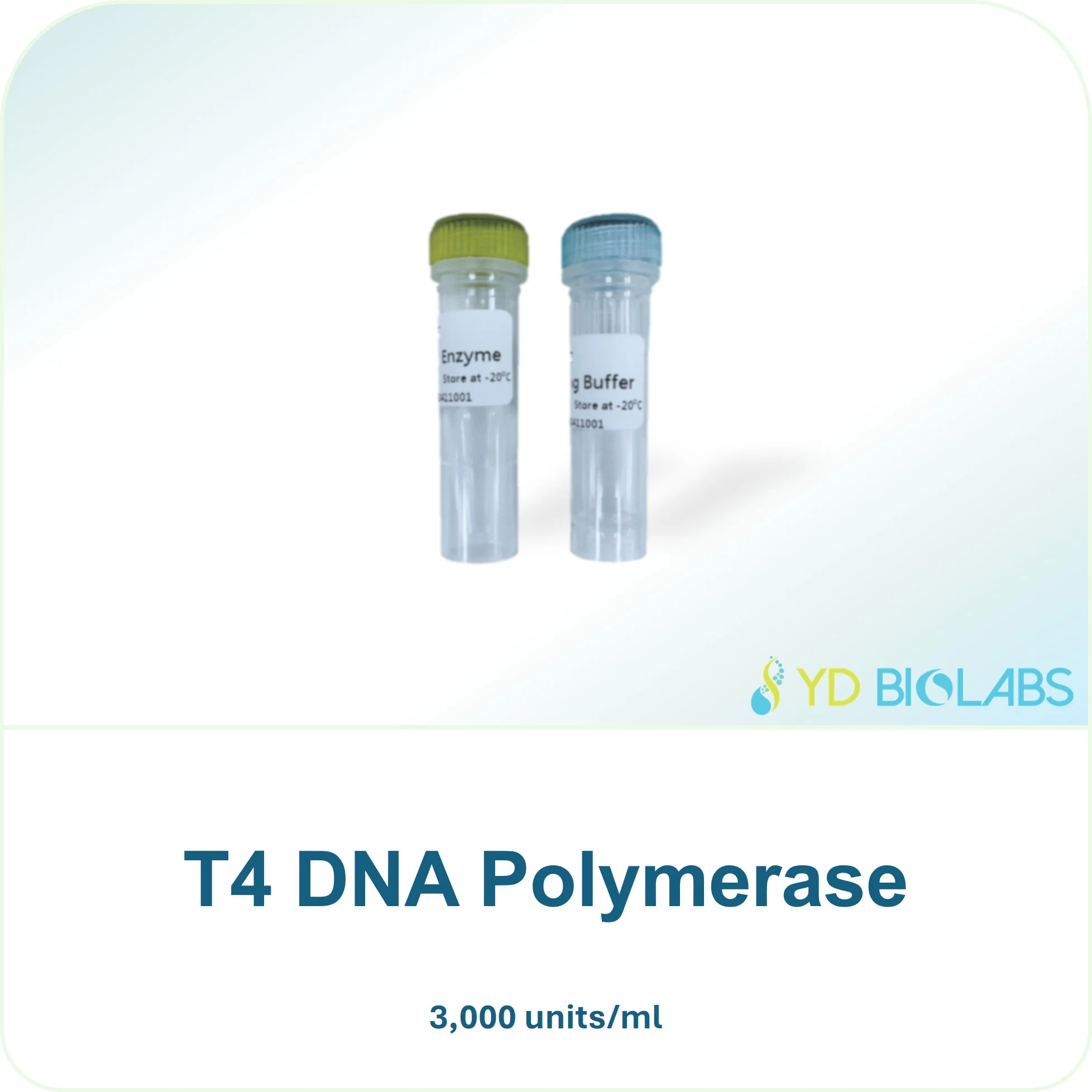
T4 DNA Polymerase
Cat. No. | Concentration | Size |
SRE00029-1 | 3,000 units/ml | 150 units |
SRE00029-2 | 3,000 units/ml | 750 units |
Description
T4 DNA Polymerase is a highly processive enzyme derived from Escherichia coli infected with T4 bacteriophage. It possesses robust 5’→3’ DNA polymerase activity and strong 3’→5’ exonuclease (proofreading) activity, making it ideal for applications requiring precise blunt-end DNA synthesis. This enzyme is widely used in molecular cloning, DNA labeling, and polishing DNA ends for ligation.
Features
- High Fidelity – Strong proofreading (3’→5’ exonuclease) ensures accurate DNA synthesis.
- Blunt-End Formation – Fills in 5’ overhangs and removes 3’ overhangs.
- Versatile – Suitable for labeling, end-repair, and site-directed mutagenesis.
- Processive – Efficiently synthesizes DNA in a template-dependent manner.
- Easy to Use – Compatible with standard DNA polymerase buffers.
Applications
- Blunt-end formation for cloning
- DNA end polishing (removing 3’ overhangs or filling 5’ overhangs)
- Radiolabeling or fluorescent labeling of DNA
- Site-directed mutagenesis
- Nick translation
Unit Definition
One unit is defined as the amount of enzyme that will incorporate 10 nmol of dNTP into acid insoluble material in 30 minutes at 37°C.
Storage Temperature
-20°C for optimal long-term stability
Storage Buffer
25 mM Tris-HCl (pH 8.0), 150 mM NaCl, 0.5 mM DTT, 0.5 mM EDTA, 50% Glycerol
Specifications
- Expression System: Escherichia coli
- Theoretical Molecular Weight: ~25,000 Daltons
- Concentration: 3,000 units/ml
- Heat Inactivation: 75°C for 20 minutes
- 5′ → 3′ Exonuclease: No
- 3′ → 5′ Exonuclease: Yes
- Strand Displacement: No
Quality Control
Each lot undergoes comprehensive testing including:
- Functional activity assays
- Purity analysis by SDS-PAGE (>95%)
- Endonuclease and DNA contamination testing
- Sterility verification
Datasheet
MSDS
Important Handling Notes:
- Avoid repeated freeze-thaw of the enzyme.
- Store at –20°C for long-term stability.
- Thaw on ice before use
- Not suitable for applications requiring 5’→3’ exonuclease activity.
- Excess enzyme can degrade DNA due to strong exonuclease activity.
Frequently Asked Questions
Q1: Can T4 DNA Polymerase create blunt ends from sticky ends?
A: Yes, it efficiently fills in 5’ overhangs and removes 3’ overhangs to generate blunt ends.
Q2: Can it be used for PCR?
A: No, it is not suitable for PCR due to its lack of thermostability.
Q3: Does it have proofreading activity?
A: Yes, it has strong 3’→5’ exonuclease activity for high-fidelity synthesis.
Troubleshooting
Problem: DNA degradation observed
- Reduce enzyme amount.
- Shorten incubation time.
- Avoid over-digestion caused by exonuclease activity.
Problem: No labeling or end repair
- Check dNTP concentrations.
- Ensure correct temperature (usually 12–37°C).
- Verify template and enzyme integrity.
Disclaimer
Research Applications Only
This product is intended for research use or further manufacturing purposes only. Not for diagnostic procedures or direct therapeutic applications.
References
DNA-dependent DNA polymerases. Current protocols in molecular biology, Chapter 3, Unit3.5. https://doi.org/10.1002/0471142727.mb0305s37