
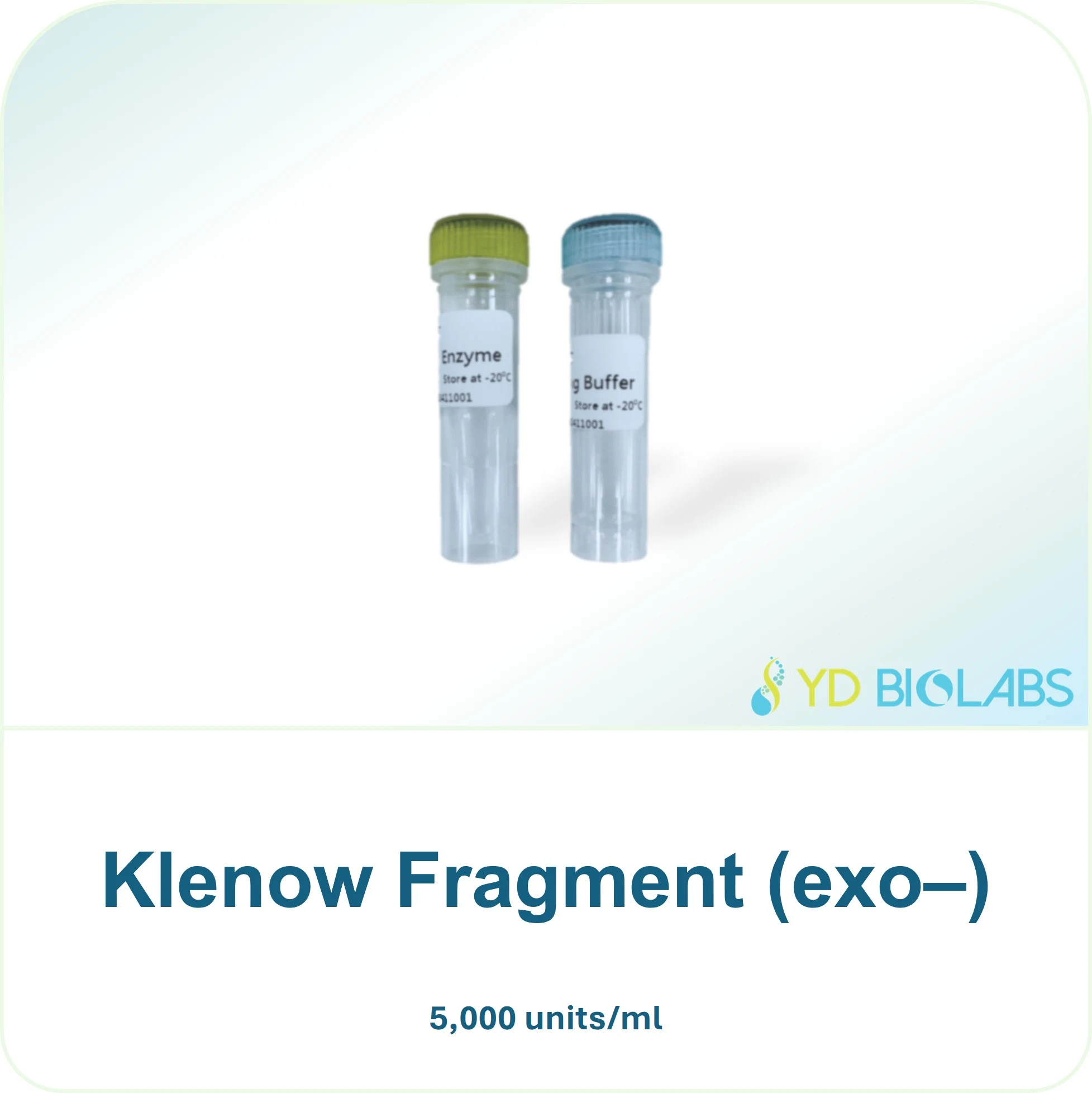
Klenow Fragment (exo–)
Cat. No. | Concentration | Size |
SRE00031-1 | 5,000 units/ml | 200 units |
SRE00031-2 | 5,000 units/ml | 1,000 units |
Description
Klenow Fragment (exo–) is a genetically engineered version of the large fragment of E. coli DNA Polymerase I, in which both the 3’→5’ (proofreading) and 5’→3’ exonuclease activities are removed. This modification preserves robust 5’→3’ polymerase activity and makes the enzyme ideal for applications such as fluorescent or radioactive labeling, second-strand cDNA synthesis, and fill-in reactions without template degradation.
Features
- No Exonuclease Activity – Lacks both 3’→5’ and 5’→3’ exonuclease, preserving DNA integrity.
- Efficient Fill-In Activity – Fills in recessed 3’ ends and overhangs.
- Ideal for Labeling – Incorporates modified nucleotides such as biotin-, digoxigenin-, or fluorescent-dNTPs.
- Compatible with Blunt-End Cloning – Generates blunt-ended DNA from overhangs.
Applications
- Fill-in 5’-overhangs of dsDNA
- 2nd strand synthesis of cDNA
- Radiolabeling or fluorescent labeling of DNA probes
- Generates probes using random primers
- DNA sequencing by the Sanger dideoxy method
Unit Definition
One unit is defined as the amount of enzyme catalyzing the incorporation of 1 nmol dTTP into acid-insoluble material in 30 minutes at 37°C.
Storage Temperature
-20°C for optimal long-term stability
Storage Buffer
25 mM Tris-HCl (pH 8.0), 150 mM NaCl, 0.5 mM DTT, 0.5 mM EDTA, 50% Glycerol
Specifications
- Expression System: Escherichia coli
- Theoretical Molecular Weight: ~68,000 Daltons
- Concentration: 5,000 units/ml
- Heat Inactivation: 75°C for 20 minutes
- 5′ → 3′ Exonuclease: No
- 3′ → 5′ Exonuclease: No
Quality Control
Each lot undergoes comprehensive testing including:
- Functional activity assays
- Purity analysis by SDS-PAGE (>95%)
- Endonuclease, Exonuclease and DNA contamination testing
- Sterility verification
Datasheet
MSDS
Important Handling Notes:
- Avoid repeated freeze-thaw of the enzyme.
- Store at –20°C for long-term stability.
- Thaw on ice before use
- Do not use for applications requiring proofreading or strand displacement.
- Compatible with modified dNTPs for probe generation.
- Use with DNA templates that require protection from degradation.
- Heat inactivation is partial; clean-up may be needed before downstream use.
Frequently Asked Questions
Q1: What is the difference between Klenow Fragment and Klenow (exo–)?
A: Klenow Fragment has 3’→5’ exonuclease (proofreading) activity, while Klenow (exo–) lacks both 3’→5’ and 5’→3’ exonuclease, making it suitable for labeling and fill-in without degradation.
Q2: Can Klenow (exo–) be used for PCR?
A: No, it is not thermostable and not suitable for PCR cycling.
Q3: Can it incorporate modified nucleotides?
A: Yes, it efficiently incorporates labeled dNTPs such as biotin-, digoxigenin-, or fluorescent-conjugated nucleotides.
Troubleshooting
Problem: Weak labeling signal
- Check dNTP or labeled nucleotide concentration.
- Ensure template is clean and not degraded.
- Avoid over-dilution of enzyme.
Problem: No blunt-end formation
- Verify DNA ends (must have recessed or overhanging 3′ ends).
- Ensure correct reaction temperature and time.
- Use sufficient enzyme units.
Disclaimer
Research Applications Only
This product is intended for research use or further manufacturing purposes only. Not for diagnostic procedures or direct therapeutic applications.
References
Tabor S, Huber HE, Richardson CC. Escherichia coli DNA polymerase I: Characterization of the 3’→5’ exonuclease-deficient mutant. J Biol Chem. 1987;262(33):16212–16223.
Maniatis T, Fritsch EF, Sambrook J. Molecular Cloning: A Laboratory Manual. Cold Spring Harbor Laboratory Press; 1982.
Rigby PW, Dieckmann M, Rhodes C, Berg P. Labeling deoxyribonucleic acid to high specific activity in vitro by nick translation with DNA polymerase I. J Mol Biol. 1977;113(2):237–251.