
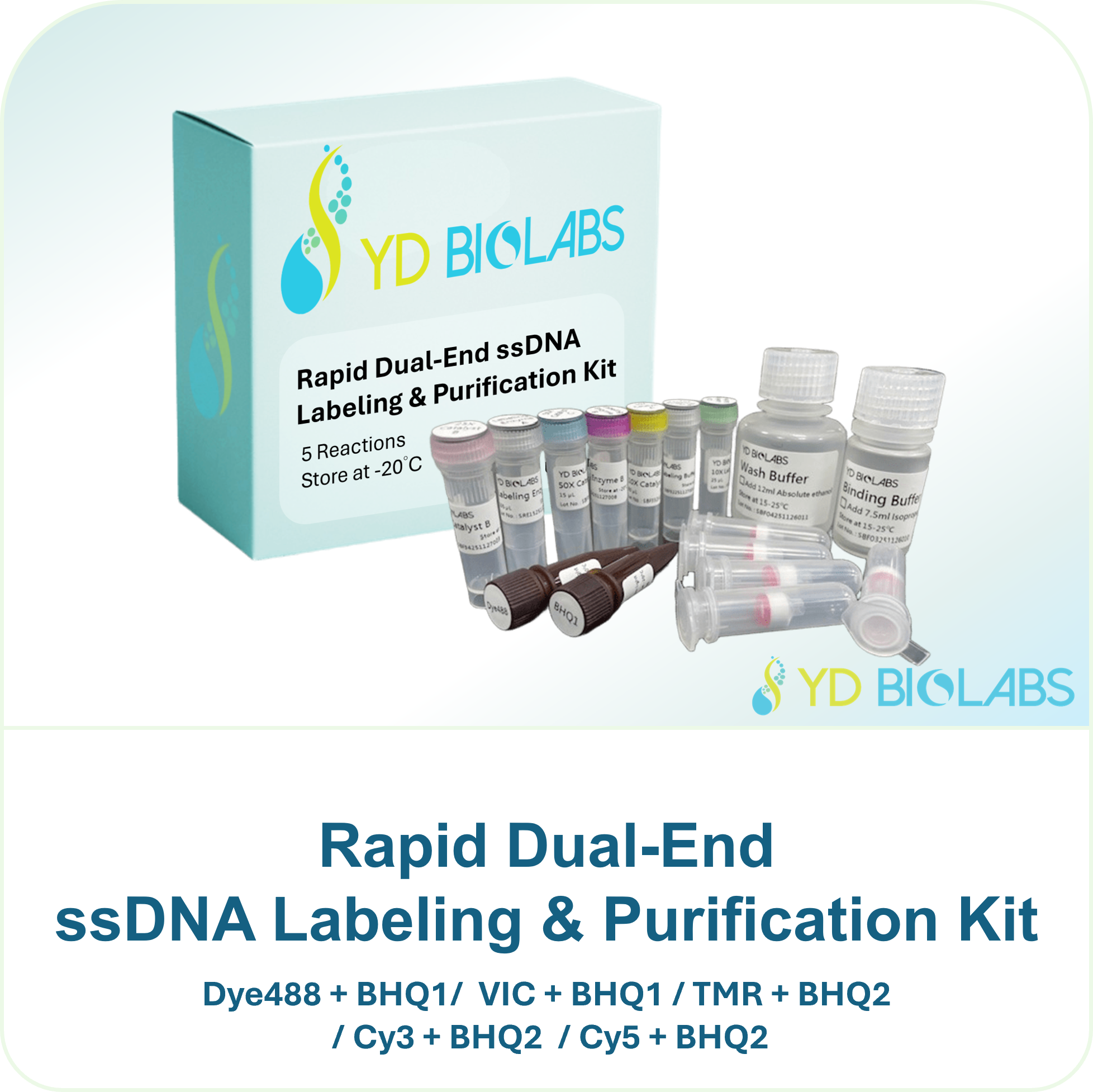
Rapid Dual-End ssDNA Labeling & Purification Kit
|
Cat. No. |
Product Name |
Reaction |
|
P3010 | P3011 |
Dual-End ssDNA Labeling Kit/with Dye488 and BHQ1 |
5 Rxn | 10 Rxn |
|
P3020 | P3021 |
Dual-End ssDNA Labeling Kit/with VIC and BHQ1 |
5 Rxn | 10 Rxn |
|
P3030 | P3031 |
Dual-End ssDNA Labeling Kit/with TMR and BHQ2 |
5 Rxn | 10 Rxn |
|
P3040 | P3041 |
Dual-End ssDNA Labeling Kit/with Cy3 and BHQ2 |
5 Rxn | 10 Rxn |
|
P3050 | P3051 |
Dual-End ssDNA Labeling Kit/with Cy5 and BHQ2 |
5 Rxn | 10 Rxn |
Description
The Rapid Dual-End ssDNA Labeling Kit enables covalent modification of both 5′ and 3′ ends of ssDNA using our patented conjugation technology. This chemistry supports sequential attachment of two distinct labels, enhancing probe versatility for multiplexed detection and diagnostic applications.
Optimized for 20–30 nt ssDNA, the kit achieves ~50% dual-labeling efficiency with 1 nmol yield per reaction. It includes all reagents and spin-column purification for a fast, high-purity workflow.
Available dye–quencher combinations include Dye488/BHQ1, VIC/BHQ1, TMR/BHQ2, Cy3/BHQ2, and Cy5/BHQ2, covering a wide fluorescence detection range.
Key Features
- Dual 5’/3’ labeling – Enables covalent modification at both termini of ssDNA for versatile probe design.
- Patented chemistry – Provides stable dual-end linkage through proprietary conjugation.
- Optimized for short oligos – Designed for 20–30 nt ssDNA with ~50% labeling efficiency.
- Balanced yield – Produces up to 1 nmol of purified dual-labeled probes per reaction.
- Streamlined workflow – All-in-one reagents with rapid spin-column purification.
- Flexible dye options – Available in five dye–quencher pairs: Dye488/BHQ1, VIC/BHQ1, TMR/BHQ2, Cy3/BHQ2, and Cy5/BHQ2.
Applications
Multiplex hybridization / assays – Dual-end labeling enables simultaneous multi-target detection and signal normalization, enhancing assay throughput and accuracy.
FRET / TaqMan qPCR/dPCR – Fluorophore–quencher (or donor–acceptor) pairing at both ends allows real-time monitoring of target binding or conformational changes for precise quantitative PCR.
Hybrid capture / NGS – One terminus supports solid-phase capture while the other provides detection or barcoding, improving target enrichment and sequencing efficiency.
Clinical quantification – Suitable for viral load monitoring, gene expression, and CNV analysis, delivering stable and highly sensitive quantification.