
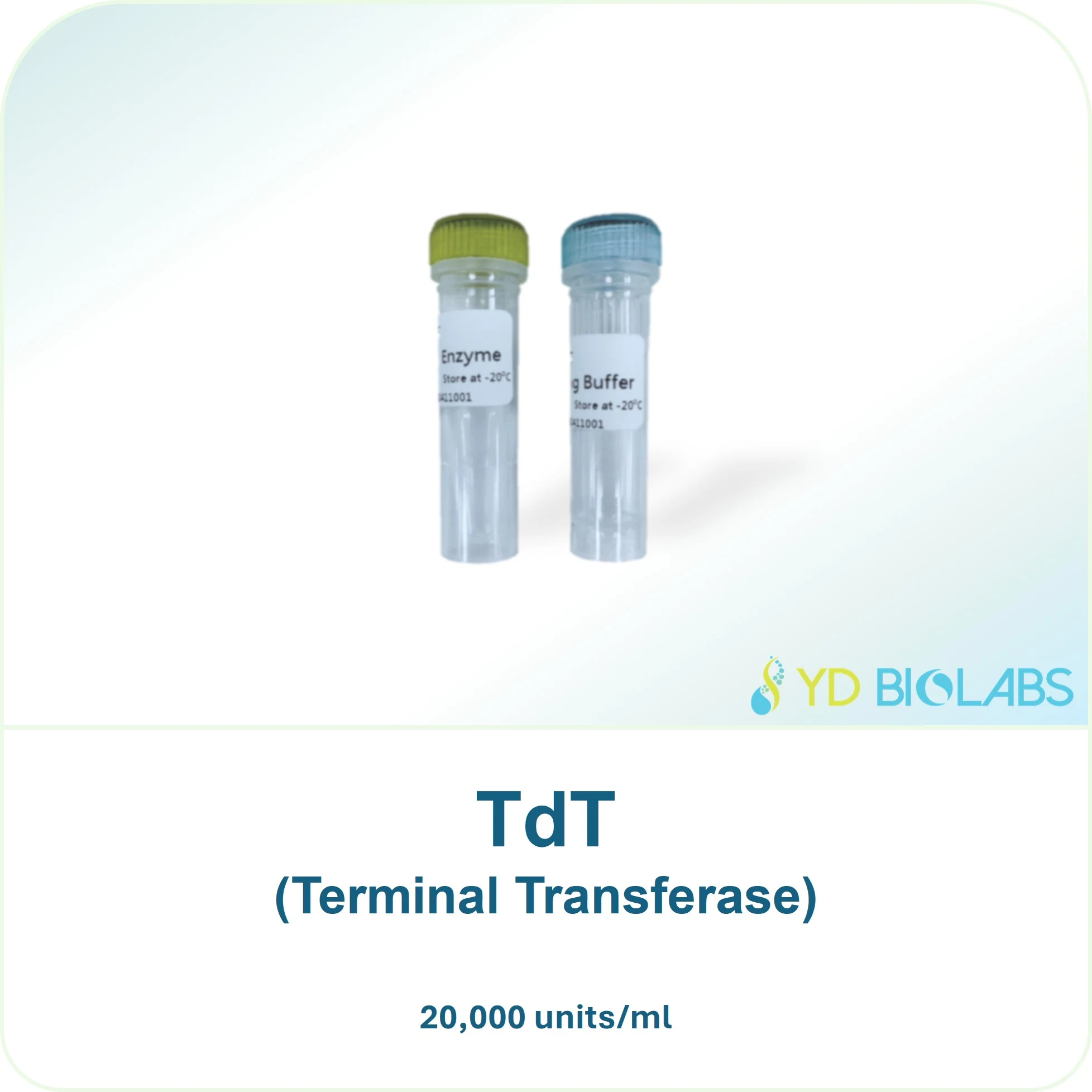
TdT (Terminal Transferase)
Cat. No. | Concentration | Size |
SRE00024-1 | 20,000 units/ml | 500 units |
SRE00024-2 | 20,000 units/ml | 2,500 units |
Description
Terminal Deoxynucleotidyl Transferase (TdT) is a unique DNA polymerase that catalyzes the addition of deoxynucleotides to the 3’-hydroxyl termini of single- or double-stranded DNA in a template-independent manner. This enzyme is ideal for labeling DNA ends with modified nucleotides (e.g., fluorescent, biotinylated, or radiolabeled dNTPs), tailing DNA fragments, or preparing DNA for cloning and detection applications.
Features
- Template-Independent Polymerase – Adds nucleotides directly to 3’ ends of DNA.
- Highly Active – Suitable for 3’-end labeling and tailing.
- Compatible with Modified dNTPs – Efficiently incorporates fluorescent or biotin-labeled nucleotides. (e.g., ddNTP, DIG-dUTP)
- Versatile for Molecular Biology Workflows – Enables labeling, detection, and cloning applications.
Applications
- 3’-end labeling of DNA with fluorescent or biotinylated nucleotides
- Homopolymer tailing for cloning
- TUNEL assay for apoptotic cell detection
- DNA fragment labeling for probe generation
Unit Definition
One unit is defined as the amount of enzyme catalyzing the incorporation of 1 nmol dTTP into acid-insoluble material in a total reaction volume of 50 ul in 1 hour at 37°C.
Storage Temperature
-20°C for optimal long-term stability
Storage Buffer
25 mM Tris-HCl (pH 8.0), 150 mM NaCl, 0.5 mM DTT, 0.5 mM EDTA, 50% Glycerol
Specifications
- Expression System: Escherichia coli
- Theoretical Molecular Weight: ~58,000 Daltons
- Concentration: 10,000 units/ml
- Heat Inactivation: 75°C for 20 minutes
- 5′ → 3′ Exonuclease: No
- 3′ → 5′ Exonuclease: No
- Strand Displacement: No
Quality Control
Each lot undergoes comprehensive testing including:
- Functional activity assays
- Purity analysis by SDS-PAGE (>95%)
- Endonuclease, Exonuclease and DNA contamination testing
- Sterility verification
Datasheet
MSDS
Important Handling Notes:
- Avoid repeated freeze-thaw of the enzyme.
- Store at –20°C for long-term stability.
- Thaw on ice before use
- TdT requires a divalent metal cofactor (Co²⁺ or Mg²⁺). Co²⁺ enhances tailing; Mg²⁺ enhances modified nucleotide incorporation.
- TdT prefers 3′-protruding (overhanging) ends; labeling efficiency may be lower with blunt or recessed ends.
- Enzyme does not require a template or primer.
- Activity is highly sensitive to buffer conditions and nucleotide concentration.
- Modified dNTPs (e.g., fluorescein-, biotin-, or aminoallyl-labeled) are well tolerated.
- Inactivated by heat and/or EDTA treatment.
Frequently Asked Questions
Q1: Can TdT add nucleotides to RNA?
A: No, TdT is specific for DNA substrates with a free 3’-OH.
Q2: What kind of DNA ends can TdT modify?
A: TdT can extend 3’-protruding, blunt, or recessed DNA ends. However, 3’-protruding ends are preferred and result in higher labeling efficiency.
Q3: Does TdT work with modified nucleotides?
A: Yes, many fluorescent or biotin-labeled dNTPs are efficiently incorporated.
Troubleshooting
Problem: No or low labeling efficiency
- Check for enzyme inactivation due to freeze-thaw or contamination.
- Ensure sufficient divalent ion concentration (Co²⁺ or Mg²⁺).
- Confirm DNA ends are free of blocking modifications (e.g., 3’-phosphate).
Problem: Non-specific signal or high background
- Reduce reaction time or enzyme concentration.
- Purify labeled product before downstream detection.
- Use nuclease-free water and clean reagents.
Disclaimer
Research Applications Only
This product is intended for research use or further manufacturing purposes only. Not for diagnostic procedures or direct therapeutic applications.
References
Roy B, Modak MJ. Cytochemical localization of TdT: a review of methodology and applications. J Histochem Cytochem. 1998;46(7):959–968. doi:10.1177/002215549804600801
Motea EA, Berdis AJ. Terminal deoxynucleotidyl transferase: the story of a misguided DNA polymerase. Biochim Biophys Acta. 2010;1804(5):1151–1166. doi:10.1016/j.bbapap.2009.10.002
Gloor JW, Guise AJ, Sweasy JB. 3′-End Labeling of DNA Using Terminal Deoxynucleotidyl Transferase. Curr Protoc Mol Biol. 2010;Chapter 3:Unit 3.10.1–3.10.6. doi:10.1002/0471142727.mb0310s91