
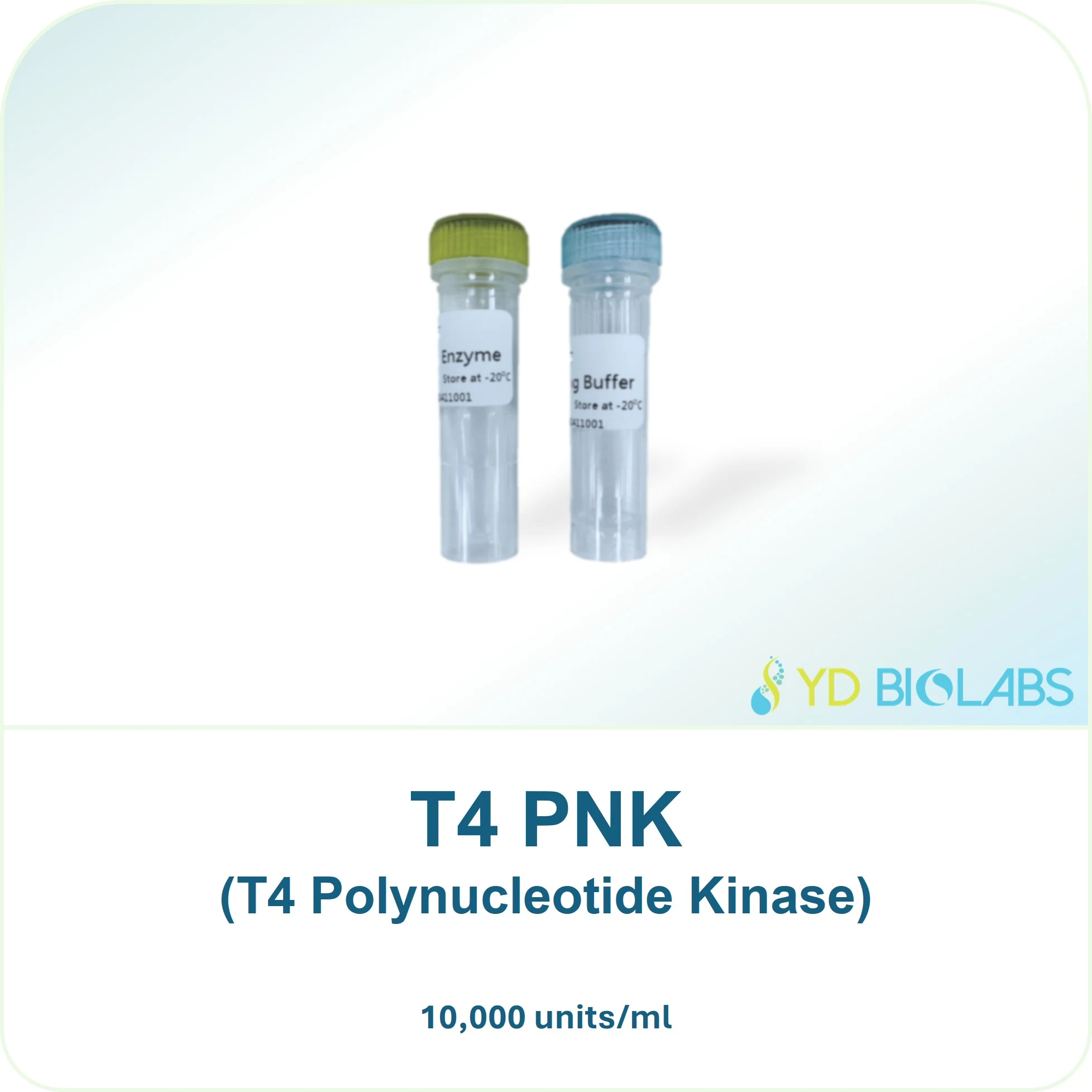
T4 PNK (T4 Polynucleotide Kinase)
Cat. No. | Concentration | Size |
SRE00025-1 | 10,000 units/ml | 500 units |
SRE00025-2 | 10,000 units/ml | 2,500 units |
Description
T4 Polynucleotide Kinase (T4 PNK) is an enzyme from bacteriophage T4 that catalyzes the transfer of the γ-phosphate from ATP to the 5’-hydroxyl termini of DNA or RNA, producing 5’-phosphorylated nucleic acids. It also possesses 3’-phosphatase activity, enabling removal of 3’-phosphate groups to generate 3’-OH ends. T4 PNK is widely used for preparing nucleic acids for ligation, radiolabeling, and various molecular biology applications that require defined phosphate termini.
Features
- Dual Activity – 5’-kinase + 3’-phosphatase activities.
- High Efficiency – Rapid phosphorylation of DNA, RNA, or oligonucleotides.
- Versatile Substrates – Works on ssDNA, dsDNA, RNA, and DNA/RNA hybrids.
- Ligation-Ready Ends – Generates 5’-phosphate and 3’-OH termini for efficient ligation.
- Labeling-Compatible – Efficiently incorporates radiolabeled [γ-³²P]ATP for probe preparation.
Applications
- 5’-end phosphorylation of DNA or RNA for ligation
- Removal of 3’-phosphate blocking groups
- Radiolabeling of DNA or RNA probes
- Preparation of linkers or adapters for cloning and sequencing
- Nucleic acid repair in in vitro systems
Unit Definition
One unit of enzyme catalyzes the phosphorylation of 20 pmol of fluorescently labeled oligo in 30 min at 37˚C.
Storage Temperature
-20°C for optimal long-term stability
Storage Buffer
25 mM Tris-HCl (pH 8.0), 150 mM NaCl, 0.5 mM DTT, 0.5 mM EDTA, 50% Glycerol
Specifications
- Expression System: Escherichia coli
- Theoretical Molecular Weight: ~33,000 Daltons
- Concentration: 10,000 units/ml
- Heat Inactivation: 65°C for 20 minutes
- 5’-Kinase Activity: Yes
- 3’-Phosphatase Activity: Yes
Quality Control
Each lot undergoes comprehensive testing including:
- Functional activity assays
- Purity analysis by SDS-PAGE (>95%)
- Endonuclease, exonuclease, DNase and DNA contamination testing
- Sterility verification
Datasheet
MSDS
Important Handling Notes:
- Avoid repeated freeze-thaw of the enzyme.
- Store at –20°C for long-term stability.
- Thaw on ice before use
- Requires ATP as a phosphate donor.
- Optimal activity in Mg²⁺-containing buffers.
- Heat inactivation is enhanced by adding EDTA to chelate Mg²⁺.
- For high-specific-activity radiolabeling, use purified oligonucleotides free from competing phosphate groups.
- Works well with linkers/adapters in ligation-based NGS library prep.
Frequently Asked Questions
Q1: Can T4 PNK phosphorylate blunt and overhanging ends?
A: Yes, it efficiently phosphorylates both blunt and sticky DNA ends, as well as RNA ends.
Q2: Can it remove 3’ phosphates?
A: Yes, the 3’-phosphatase activity generates 3’-OH ends, making them ligation-compatible.
Q3: Is ATP always required?
A: Yes, ATP is needed for kinase activity. However, the 3’-phosphatase activity does not require ATP.
Troubleshooting
Problem: Low phosphorylation efficiency
- Ensure ATP and Mg²⁺ are present.
- Purify nucleic acid to remove inhibitors.
- Increase enzyme units or incubation time.
Problem: No ligation after phosphorylation
- Verify removal of 3′-phosphate groups if present.
- Heat-inactivate PNK before ligation to avoid unwanted phosphate cycling.
Disclaimer
Research Applications Only
This product is intended for research use or further manufacturing purposes only. Not for diagnostic procedures or direct therapeutic applications.
References
Richardson CC. Phosphorylation of nucleic acid termini by T4 polynucleotide kinase. Proc Natl Acad Sci USA. 1965;54(1):158–165.
Cameron V, Uhlenbeck OC. 3’-Phosphatase activity in T4 polynucleotide kinase. Biochemistry. 1977;16(23):5120–5126.
Sambrook J, Russell DW. Molecular Cloning: A Laboratory Manual. Cold Spring Harbor Laboratory Press; 2001.