
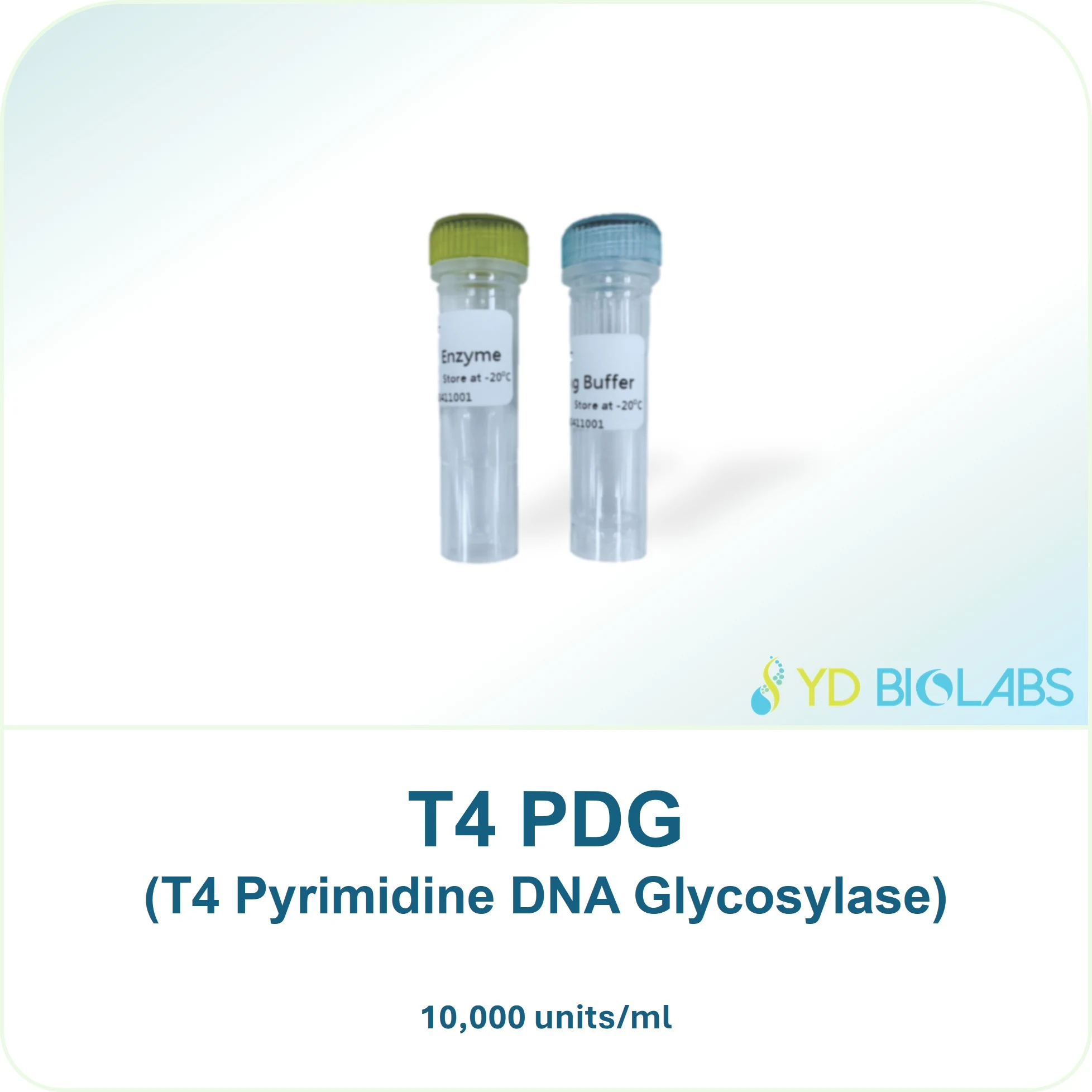
T4 PDG (T4 Pyrimidine DNA Glycosylase)
Cat. No. | Concentration | Size |
SRE00020-1 | 10,000 units/ml | 2,000 units |
SRE00020-2 | 10,000 units/ml | 10,000 units |
Description
T4 Pyrimidine DNA Glycosylase (T4 PDG), also known as T4 Endonuclease V, is a DNA repair enzyme from bacteriophage T4 that specifically recognizes cyclobutane pyrimidine dimers (CPDs) formed by UV irradiation. The enzyme possesses DNA glycosylase activity, which removes the damaged pyrimidine base, followed by AP lyase activity that cleaves the DNA backbone at the lesion site. This dual function makes T4 PDG a valuable tool for detecting and quantifying UV-induced DNA damage and for studying DNA repair pathways.
Features
- Dual Enzymatic Activities – DNA glycosylase + AP lyase.
- Specific for CPDs – Recognizes UV-induced cyclobutane pyrimidine dimers in DNA.
- Broad Substrate Compatibility – Works on dsDNA, ssDNA, and oligonucleotides containing CPDs.
- Generates Ligation-Compatible Ends – Produces 3’-OH and 5’-phosphate termini.
Applications
- Detection and quantitation of UV-induced DNA damage
- Mapping of CPD lesions in genomic DNA
- Removal of CPDs prior to DNA amplification or cloning
- In vitro DNA repair studies
- Preparation of defined DNA breaks for ligation-mediated assays
Unit Definition
One unit is defined as the amount of enzyme that catalyzes the conversion of 0.5 µg of UV irradiated supercoiled pUC19 DNA to > 95% nicked plasmid in 30 minutes at 37°C. Nicking is assessed by agarose gel electrophoresis. Irradiated plasmid contains an average of 3-5 pyrimidine dimers.
Storage Temperature
-20°C for optimal long-term stability
Storage Buffer
25 mM Tris-HCl (pH 8.0), 150 mM NaCl, 0.5 mM DTT, 0.5 mM EDTA, 50% Glycerol
Specifications
- Expression System: Escherichia coli
- Theoretical Molecular Weight: ~16,000 Daltons
- Concentration: 10,000 units/ml
- Heat Inactivation: No
- Glycosylase Activity: Yes (CPDs)
- AP Lyase Activity: Yes (β-elimination)
Quality Control
Each lot undergoes comprehensive testing including:
- Functional activity assays
- Purity analysis by SDS-PAGE (>95%)
- Exonuclease, DNase and DNA contamination testing
- Sterility verification
Datasheet
MSDS
Important Handling Notes:
- Avoid repeated freeze-thaw of the enzyme.
- Store at –20°C for long-term stability.
- Thaw on ice before use
- Specific to cyclobutane pyrimidine dimers; does not recognize 6-4 photoproducts.
- Produces single-strand breaks at lesion sites for downstream repair or labeling.
- Can be coupled with photolyases or other DNA glycosylases for comprehensive UV-damage repair analysis.
- Optimal activity in Mg²⁺-containing buffers.
- Not active on undamaged DNA.
Frequently Asked Questions
Q1: Can T4 PDG work on RNA?
A: No, T4 PDG is specific to DNA containing CPDs.
Q2: How is T4 PDG different from Endonuclease III (Nth) or FPG?
A: T4 PDG recognizes UV-induced pyrimidine dimers, while Endo III and FPG target oxidized pyrimidines and purines, respectively.
Q3: Can I use T4 PDG before PCR to reduce UV damage bias?
A: Yes, removing CPDs before amplification can improve yield and reduce sequence artifacts.
Troubleshooting
Problem: Low cleavage efficiency
- Ensure DNA contains CPDs (e.g., UV-irradiated DNA).
- Verify optimal buffer and temperature.
- Increase enzyme concentration or incubation time.
Problem: Non-specific cleavage
- Reduce enzyme concentration or shorten incubation.
- Check DNA purity; contaminants may produce background signals.
Disclaimer
Research Applications Only
This product is intended for research use or further manufacturing purposes only. Not for diagnostic procedures or direct therapeutic applications.
References
Haseltine WA, Gordon LK, Lindan CP, Grafstrom RH, Shaper NL, Grossman L. Cleavage of pyrimidine dimers in DNA by a pyrimidine dimer glycosylase of bacteriophage T4. J Biol Chem. 1980;255(18):9337–9343.
Lloyd RS. Biological properties of pyrimidine dimer glycosylase. Mutat Res. 1982;94(4):401–410.
Yasui A, McCready SJ. Alternative repair pathways for UV-damaged DNA. Mutat Res. 1998;408(1):1–9.