
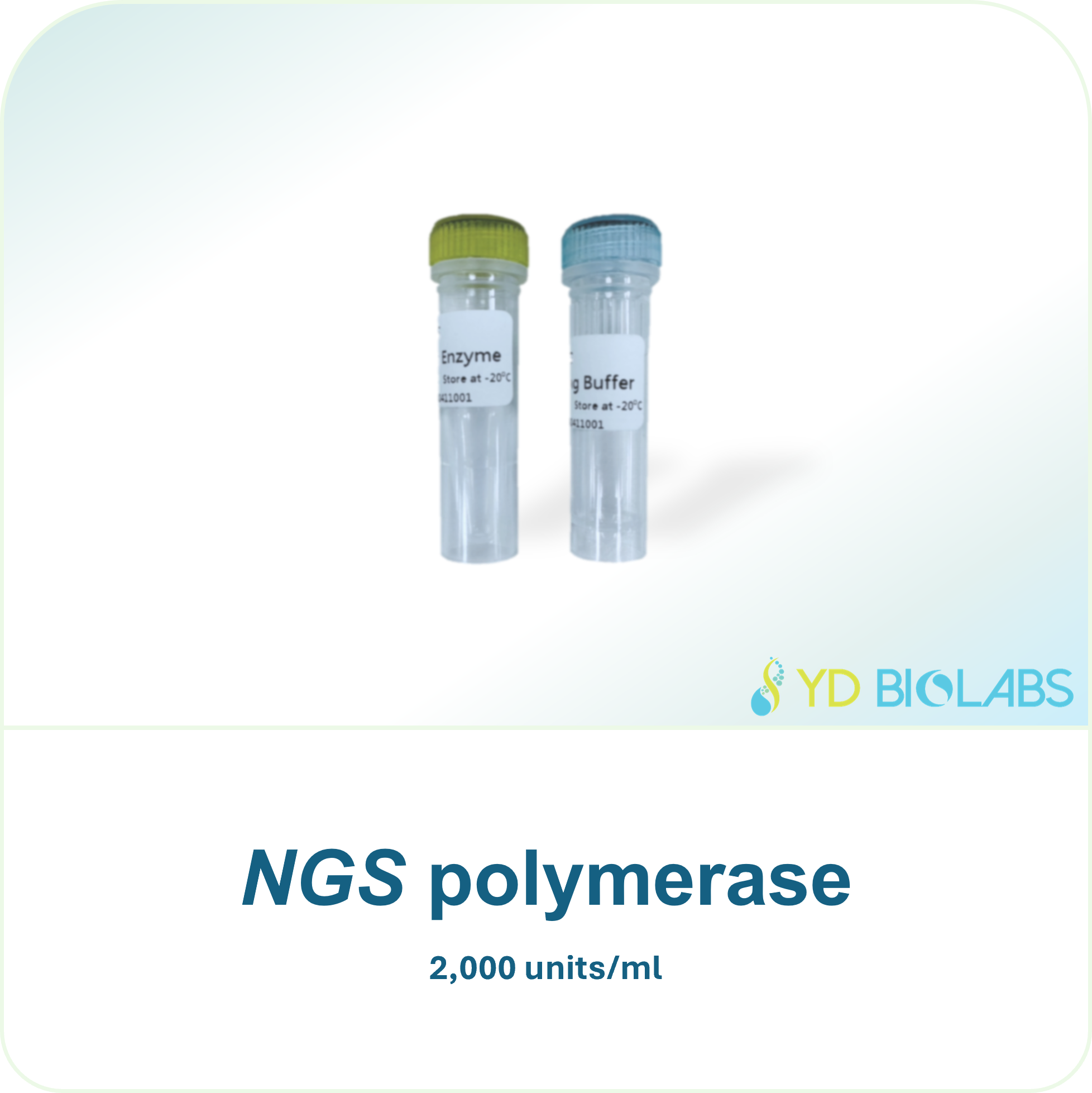
NGS Polymerase
Cat. No. | Concentration | Size |
SRE00019-1 | 2,000 units/ml | 200 units |
SRE00019-2 | 2,000 units/ml | 1000 units |
Description
NGS Polymerase is a thermostable, engineered DNA polymerase with broad substrate flexibility. Designed for incorporation of a wide range of modified nucleotides—including dye-labeled, biotinylated, or chain-terminating analogs—this enzyme is ideal for applications such as next-generation sequencing, DNA labeling, and aptamer generation. NGS Polymerase exhibits strong 5’→3’ polymerase activity and robust thermostability, making it suitable for high-temperature reactions or synthesis requiring structural nucleotide analogs.
Features
- Compatible with Modified dNTPs – Efficiently incorporates a broad range of modified nucleotides (e.g., Cy5-, biotin-, 2’-fluoro-, dideoxy-).
- Thermostable – Optimal activity at 65–72°C.
- High Processivity – Supports long extension and efficient synthesis.
- Fidelity Tuned for Tolerance – Designed to accommodate nucleotide analogs with minimal discrimination.
Applications
- Incorporation of labeled or unnatural nucleotides
- Direct labeling of DNA probes
- DNA synthesis with chain-terminating or fluorinated nucleotides
- Aptamer selection with modified bases
- Preparation of sequencing libraries with nucleotide analogs
Unit Definition
One unit is defined as the amount of enzyme catalyzing the incorporation of 10 nmol dNTP into acid-insoluble material in 30 minutes at 75°C.
Storage Temperature
-20°C for optimal long-term stability
Storage Buffer
25 mM Tris-HCl (pH 8.0), 150 mM NaCl, 0.5 mM DTT, 0.5 mM EDTA, 50% Glycerol
Specifications
- Expression System: Escherichia coli
- Theoretical Molecular Weight: ~95,000 Daltons
- Concentration: 2,000 units/ml
- Heat Inactivation: No
- 5′ → 3′ Exonuclease: No
- 3′ → 5′ Exonuclease: No
- Strand Displacement: Yes
Quality Control
Each lot undergoes comprehensive testing including:
- Functional activity assays
- Purity analysis by SDS-PAGE (>95%)
- Endonuclease, Exonuclease and DNA contamination testing
- Sterility verification
Datasheet
MSDS
Important Handling Notes:
- Avoid repeated freeze-thaw of the enzyme.
- Store at –20°C for long-term stability.
- Thaw on ice before use
- SBS DNA Polymerase is specifically engineered to reduce discrimination against base-modified or sugar-modified nucleotides.
- Not recommended for high-fidelity PCR.
- For optimal incorporation of bulky or base-modified nucleotides, increase reaction time or adjust temperature.
- Compatible with ddNTPs and 2’-F-dNTPs for chain termination or enhanced nuclease resistance.
Frequently Asked Questions
Q1: Can SBS DNA Polymerase incorporate 2′-fluoro or 2′-O-methyl dNTPs?
A: Yes, SBS DNA Polymerase efficiently incorporates several sugar-modified nucleotides, including 2′-F and 2′-OMe analogs.
Q2: Is SBS DNA Polymerase suitable for standard PCR?
A: While it can be used for amplification, its design favors tolerance to modified nucleotides over replication fidelity, making it suboptimal for high-accuracy PCR.
Q3: Can it be used for dye-labeled probe synthesis?
A: Yes, it readily incorporates Cy5-, Cy3-, or fluorescein-labeled nucleotides.
Troubleshooting
Problem: Modified nucleotide not incorporated
- Confirm correct analog type and structure.
- Increase analog : dNTP ratio.
- Extend reaction time or increase enzyme amount.
Problem: No product or poor yield
- Check template purity and structure.
- Use fresh analogs and confirm buffer compatibility.
Adjust Mg²⁺ concentration if required by the modified dNTP.
Disclaimer
Research Applications Only
This product is intended for research use or further manufacturing purposes only. Not for diagnostic procedures or direct therapeutic applications.
References