
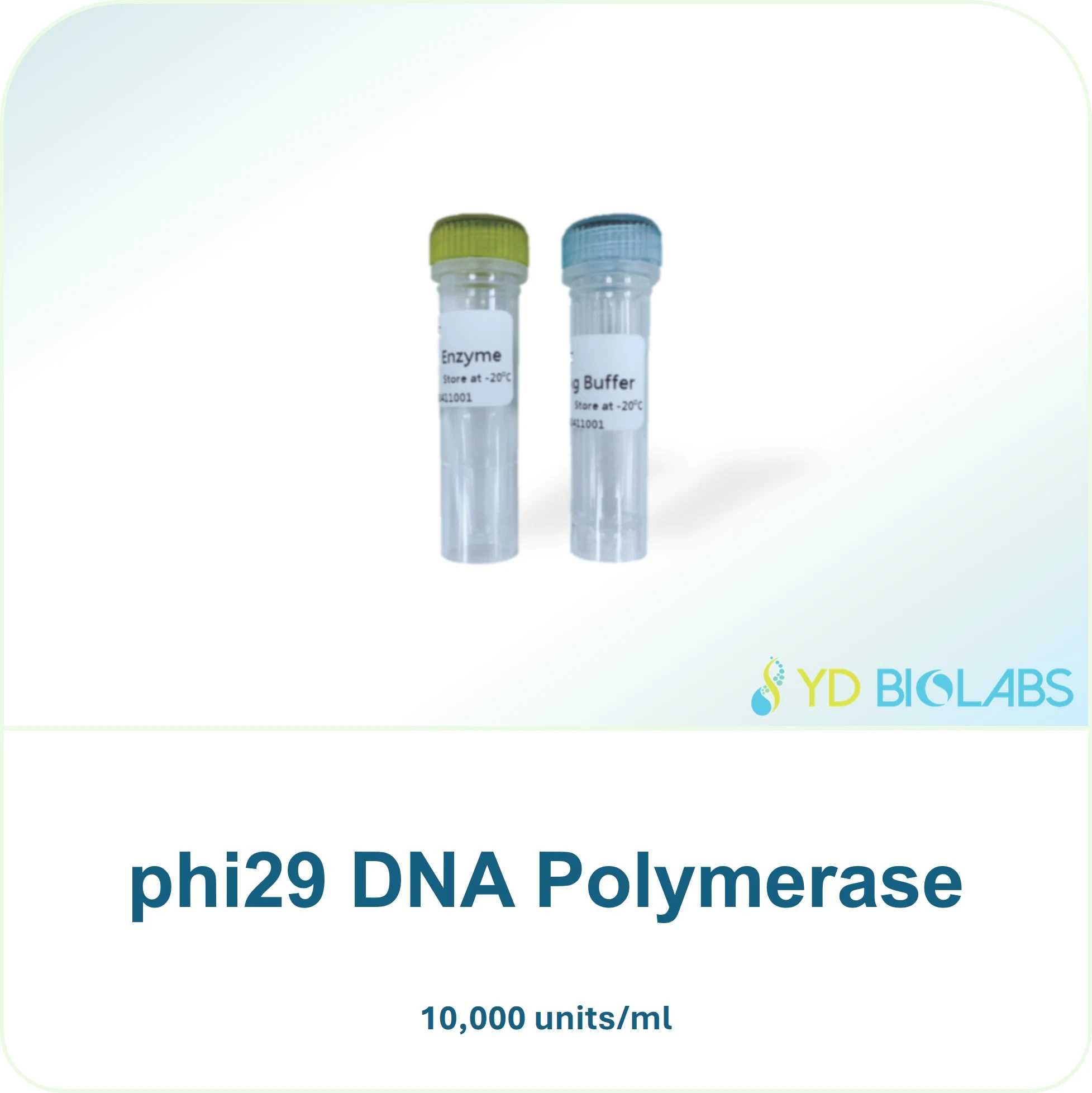
phi29 DNA Polymerase
Cat. No. | Concentration | Size |
SRE00030-1 | 10,000 units/ml | 250 units |
SRE00030-2 | 10,000 units/ml | 1,250 units |
Description
phi29 DNA Polymerase is a highly processive, strand-displacing DNA polymerase derived from Bacillus subtilis phage Phi29. It exhibits strong 5’→3’ polymerase activity and 3’→5’ exonuclease proofreading activity, enabling ultra-high fidelity DNA synthesis. Its robust strand displacement activity makes it ideal for isothermal amplification techniques such as multiple displacement amplification (MDA) and whole genome amplification (WGA), particularly when working with minute or degraded DNA samples.
Features
- Exceptional Fidelity – Proofreading 3’→5’ exonuclease activity ensures accurate DNA replication.
- Strong Strand Displacement – Enables efficient isothermal amplification without heat denaturation.
- High Processivity – Synthesizes DNA fragments >70 kb in length.
- Thermostable for Long Reactions – Stable at 30°C for extended amplification (>16 hrs).
Applications
- Whole Genome Amplification (WGA)
- Multiple Displacement Amplification (MDA)
- Single-cell genomics
- DNA template preparation for sequencing
- Circular DNA amplification (e.g., RCA)
Unit Definition
One unit is defined as the amount of enzyme that will incorporate 0.5 pmol of dNTP into acid insoluble material in 30 minutes at 30°C.
Storage Temperature
-20°C for optimal long-term stability
Storage Buffer
25 mM Tris-HCl (pH 8.0), 150 mM NaCl, 0.5 mM DTT, 0.5 mM EDTA, 50% Glycerol
Specifications
- Expression System: Escherichia coli
- Theoretical Molecular Weight: ~67,000 Daltons
- Concentration: 10,000 units/ml
- Heat Inactivation: 65°C for 10 minutes
- 5′ → 3′ Exonuclease: No
- 3′ → 5′ Exonuclease: Yes
- Strand Displacement: Yes
Quality Control
Each lot undergoes comprehensive testing including:
- Functional activity assays
- Purity analysis by SDS-PAGE (>95%)
- Endonuclease, non-Specific DNase and DNA contamination testing
- Sterility verification
Datasheet
MSDS
Important Handling Notes:
- Avoid repeated freeze-thaw of the enzyme.
- Store at –20°C for long-term stability.
- Thaw on ice before use
- Not recommended for high-temperature reactions (optimal at 30°C).
- Exonuclease activity may degrade primers if reaction is delayed.
- Use dNTP mix and buffer optimized for MDA for best performance.
- Circular or linear DNA templates are both acceptable.
Frequently Asked Questions
Q1: Can phi29 DNA Polymerase be used for LAMP?
A: No, it is not suitable for LAMP which requires higher temperature and different enzyme characteristics. Bst DNA polymerase is the preferred choice for LAMP.
Q2: Why is my reaction failing after long incubation?
A: Possible primer degradation by 3’→5’ exonuclease. Use modified primers or reduce pre-incubation time.
Q3: Is phi29 DNA Polymerase heat-inactivatable?
A: Yes, heat at 65°C for 10 minutes.
Troubleshooting
Problem: No amplification observed
- Check template quality and ensure DNA is not crosslinked or too degraded.
- Use sufficient incubation time (typically ≥4 hrs).
- Confirm optimal reaction temperature (30°C).
Problem: Smearing or non-specific amplification
- Reduce amplification time.
- Use less enzyme or template.
- Ensure contamination-free setup due to high sensitivity.
Disclaimer
Research Applications Only
This product is intended for research use or further manufacturing purposes only. Not for diagnostic procedures or direct therapeutic applications.
References
Dean FB, Hosono S, Fang L, et al. Comprehensive human genome amplification using multiple displacement amplification. Proc Natl Acad Sci USA. 2002;99(8):5261–5266. doi:10.1073/pnas.082089499
Blanco L, Bernad A, Lázaro JM, et al. Highly efficient DNA synthesis by the phage Phi29 DNA polymerase. J Biol Chem. 1989;264(15):8935–8940.
Paez JG, Lin M, Beroukhim R, et al. Genome coverage and sequence fidelity of Phi29 polymerase-based multiple strand displacement whole genome amplification. Nucleic Acids Res. 2004;32(9):e71. doi:10.1093/nar/gnh069
Esteban JA, Blanco L, Salas M. Fidelity of Phi29 DNA polymerase. Comparison between protein-primed initiation and DNA polymerization. J Biol Chem. 1993;268(4):2719–2726.