
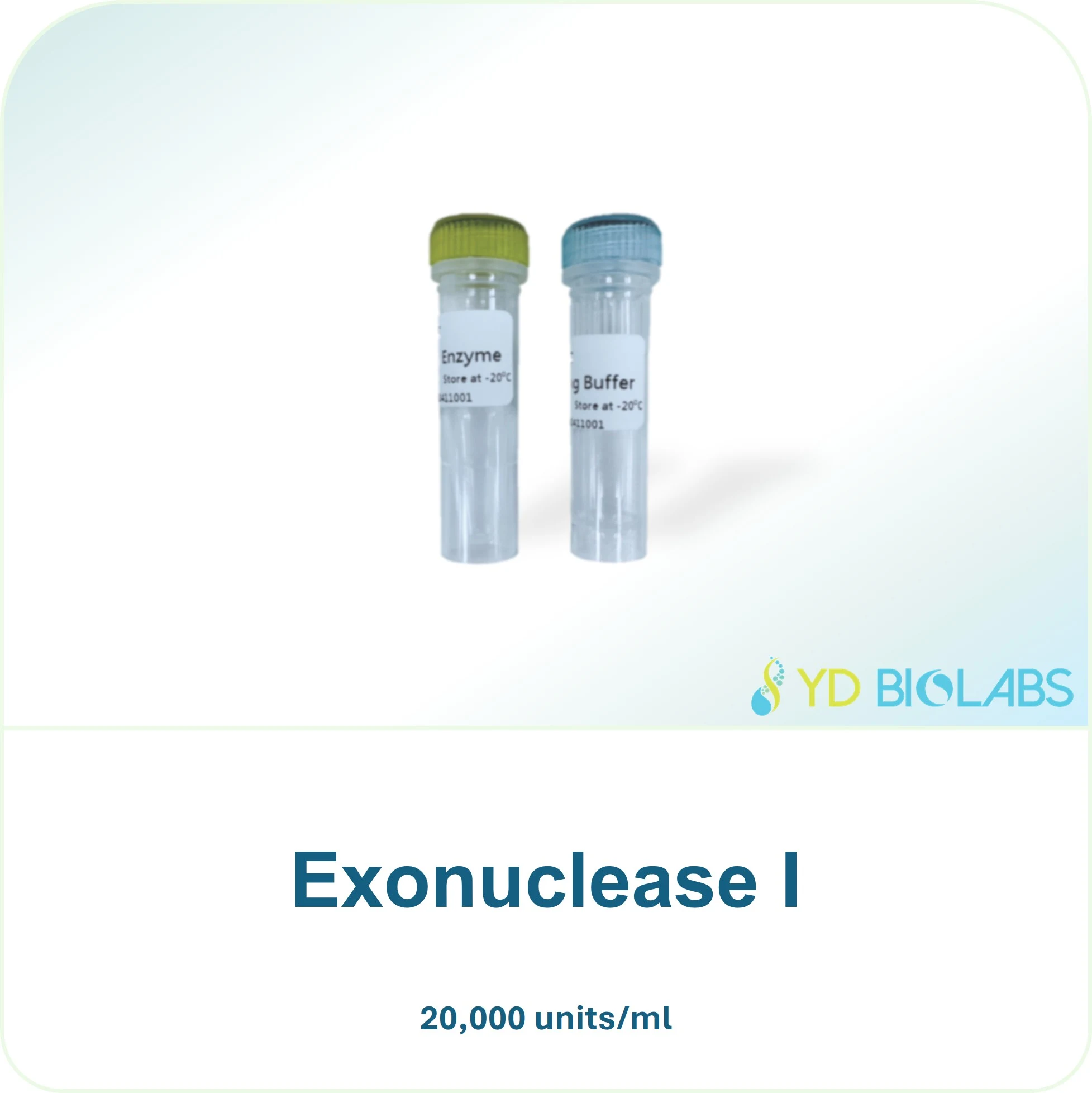
Exonuclease I
Cat. No. | Concentration | Size |
SRE00023-1 | 20,000 units/ml | 3,000 units |
SRE00023-2 | 20,000 units/ml | 15,000 units |
Description
Exonuclease I is a 3’→5’ exonuclease that specifically degrades single-stranded DNA (ssDNA) into deoxyribonucleoside 5’-monophosphates. It does not act on double-stranded DNA (dsDNA) or RNA, making it ideal for removing residual primers in PCR clean-up, degrading single-stranded oligonucleotides, or eliminating unincorporated labeled probes. This property enables high-purity DNA preparations for downstream applications such as sequencing and cloning.
Features
- High Specificity – Selectively degrades ssDNA without affecting dsDNA or RNA.
- Efficient Primer Removal – Eliminates residual primers and ssDNA contaminants.
- 3’→5’ Exonuclease Activity Only – No polymerase or endonuclease activity.
- Robust and Reliable – Works in a variety of buffer conditions.
Applications
- Removal of single-stranded primers after PCR
- Elimination of unhybridized ssDNA in hybridization assays
- Clean-up of labeled ssDNA probes
- ssDNA degradation in cloning workflows
- Preparation of high-quality templates for sequencing
Unit Definition
One unit is defined as the amount of enzyme that will catalyze the release of 10 nmol of acid-soluble nucleotide in 30 minutes at 37°C.
Storage Temperature
-20°C for optimal long-term stability
Storage Buffer
25 mM Tris-HCl (pH 8.0), 150 mM NaCl, 0.5 mM DTT, 0.5 mM EDTA, 50% Glycerol
Specifications
- Expression System: Escherichia coli
- Theoretical Molecular Weight: ~25,000 Daltons
- Concentration: 20,000 units/ml
- Heat Inactivation: 80°C for 20 minutes
- 5′ → 3′ Exonuclease: No
- 3′ → 5′ Exonuclease: Yes
Quality Control
Each lot undergoes comprehensive testing including:
- Functional activity assays
- Purity analysis by SDS-PAGE (>95%)
- Endonuclease and DNA contamination testing
- Sterility verification
Datasheet
MSDS
Important Handling Notes:
- Avoid repeated freeze-thaw of the enzyme.
- Store at –20°C for long-term stability.
- Thaw on ice before use
- Not suitable for applications requiring 5’→3’ exonuclease activity.
- Requires Mg²⁺ for activity.
- Ensure reaction buffers do not contain EDTA (which chelates Mg²⁺).
Frequently Asked Questions
Q1: Can Exonuclease I digest RNA?
A: No, it is specific to ssDNA and has no detectable RNase activity.
Q2: Can it be used to remove primers from PCR products?
A: Yes, it is highly effective for primer removal without degrading the dsDNA amplicon.
Q3: Does it degrade double-stranded DNA with nicks or overhangs?
A: It will not digest intact dsDNA, but may act on single-stranded overhang regions.
Troubleshooting
Problem: Primers remain after digestion
- Confirm enzyme was not heat-inactivated before use.
- Check Mg²⁺
- Increase incubation time or enzyme units.
Problem: Unexpected degradation of product
- Check if product has single-stranded overhangs or regions.
- Reduce enzyme amount or shorten digestion time.
Disclaimer
Research Applications Only
This product is intended for research use or further manufacturing purposes only. Not for diagnostic procedures or direct therapeutic applications.
References
Lehman IR, Nussbaum AL. The deoxyribonuclease of Escherichia coli. J Biol Chem. 1964;239:2628–2636.
Lindahl T, Andersson A. Rate of chain growth in enzymatic deoxyribonucleic acid synthesis. Biochemistry. 1972;11(19):3618–3623.
Richardson CC, Lehman IR, Kornberg A. A deoxyribonucleic acid phosphatase–exonuclease from Escherichia coli. J Biol Chem. 1964;239:251–258.