
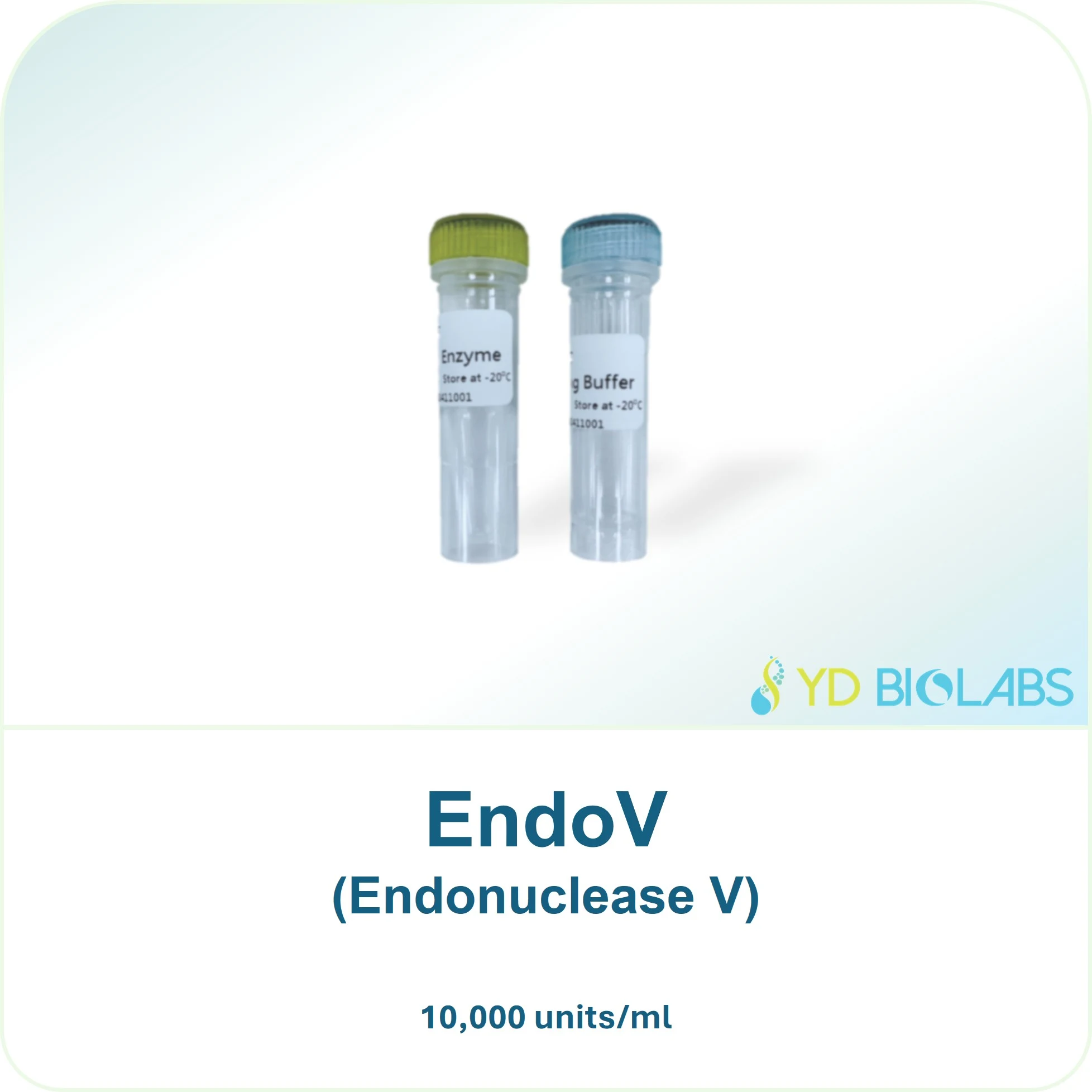
EndoV (Endonuclease V)
Cat. No. | Concentration | Size |
SRE00033-1 | 10,000 units/ml | 250 units |
SRE00033-2 | 10,000 units/ml | 1,250 units |
Description
Endonuclease V (EndoV) is a DNA and RNA repair enzyme that specifically recognizes deaminated bases, primarily inosine (deaminated adenine), in double-stranded or single-stranded DNA and RNA. It cleaves the phosphodiester backbone on the 3’ side of the lesion, generating a nick with a 5’-phosphate and a 3’-OH end. EndoV is widely used for studying DNA/RNA damage caused by deamination and for targeted cleavage at inosine sites in molecular biology workflows.
Features
- High Specificity – Recognizes inosine in DNA and RNA.
- Precise Cleavage – Nicks phosphodiester backbone 1 nucleotide 3’ to the lesion.
- Active on dsDNA, ssDNA, and RNA – Versatile substrate recognition.
- Compatible with Downstream Processing – Leaves ends suitable for ligation or polymerase extension.
Applications
- Detection and mapping of inosine in genomic DNA or RNA
- Analysis of A-to-I RNA editing
- Removal of deaminated adenine lesions from DNA
- Targeted cleavage at inosine sites prior to sequencing
- Damage-specific cleavage for repair pathway studies
Unit Definition
One unit is defined as the amount of enzyme required to cleave 1 pmol of an oligonucleotide duplex containing a single deoxyinosine site in 1 hour at 37°C.
Storage Temperature
-20°C for optimal long-term stability
Storage Buffer
25 mM Tris-HCl (pH 8.0), 150 mM NaCl, 0.5 mM DTT, 0.5 mM EDTA, 50% Glycerol
Specifications
- Expression System: Escherichia coli
- Theoretical Molecular Weight: ~29,000 Daltons
- Concentration: 10,000 units/ml
- Heat Inactivation: 65°C for 20 minutes
- Activity: Cleaves at inosine (deaminated adenine) in DNA or RNA
- Optimal Temperature: 37°C
Quality Control
Each lot undergoes comprehensive testing including:
- Functional activity assays
- Purity analysis by SDS-PAGE (>95%)
- DNase and DNA contamination testing
- Sterility verification
Datasheet
MSDS
Important Handling Notes:
- Avoid repeated freeze-thaw of the enzyme.
- Store at –20°C for long-term stability.
- Thaw on ice before use
- EndoV cleaves one nucleotide downstream (3’ side) of the lesion.
- Requires Mg²⁺ or Mn²⁺ for activity.
- Suitable for both DNA and RNA substrates.
- Not active on undamaged DNA or RNA.
- For mapping A-to-I editing sites in RNA, combine with reverse transcription and sequencing
Frequently Asked Questions
Q1: How is EndoV different from EndoQ?
A: EndoV specifically recognizes inosine (from adenine deamination) and cleaves 3’ to the lesion; EndoQ recognizes uracil, hypoxanthine, xanthine, and AP sites, and cleaves on the 5’ side.
Q2: Can EndoV work on RNA?
A: Yes, it can cleave inosine-containing RNA and is often used for A-to-I editing analysis.
Q3: Does EndoV remove the damaged base?
A: No, EndoV is an endonuclease, not a glycosylase. It nicks near the lesion but does not excise the base itself.
Troubleshooting
Problem: Low cleavage efficiency
- Confirm presence of inosine in the substrate.
- Ensure Mg²⁺ or Mn²⁺ is present.
- Increase enzyme concentration or incubation time.
Problem: Non-specific cleavage
- Reduce enzyme concentration.
- Shorten reaction time.
- Verify substrate purity—contaminants may cause apparent background.
Disclaimer
Research Applications Only
This product is intended for research use or further manufacturing purposes only. Not for diagnostic procedures or direct therapeutic applications.
References
Yao M, et al. Recognition and cleavage of deoxyinosine-containing DNA by endonuclease V. J Biol Chem. 1994;269(50):31390–31396.
Morikawa K, et al. Substrate specificity of Endonuclease V. Nucleic Acids Res. 2000;28(17):3418–3424.
Feng Y, et al. Endonuclease V as a probe for A-to-I RNA editing. RNA. 2006;12(9):1514–1521.