
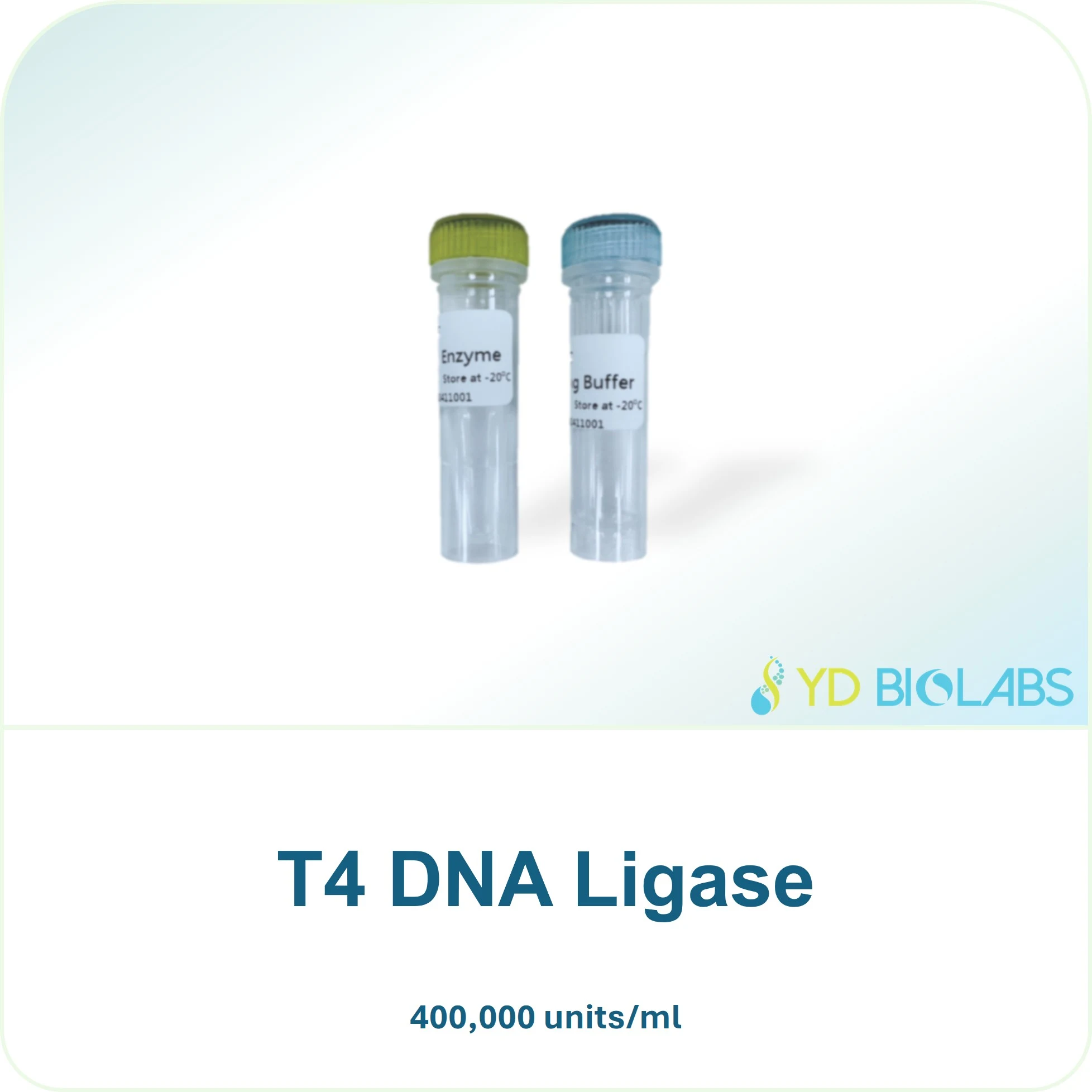
T4 DNA Ligase
Cat. No. | Concentration | Size |
SRE00036-1 | 400,000 units/ml | 20,000 units |
SRE00036-2 | 400,000 units/ml | 100,000 units |
Description
T4 DNA Ligase is an ATP-dependent ligase from bacteriophage T4 that catalyzes the formation of phosphodiester bonds between adjacent 3′-hydroxyl and 5′-phosphate termini in double-stranded nucleic acids. It efficiently joins blunt-ended or cohesive-ended DNA fragments, repairs nicks in double-stranded DNA, and can also ligate RNA or DNA/RNA hybrids. Due to its high efficiency and versatility, T4 DNA Ligase is a staple enzyme in cloning, library preparation, and molecular biology workflows.
Features
- Broad Substrate Range – Joins cohesive or blunt-ended dsDNA, RNA, and DNA/RNA hybrids.
- High Efficiency – Works effectively at low DNA concentrations.
- Blunt-End Compatible – Ideal for blunt-end cloning and adapter ligation.
- ATP-Dependent – Requires ATP as a cofactor for activity.
- Molecular Biology Standard – Widely used in cloning and NGS library construction.
Applications
- DNA cloning via cohesive or blunt-end ligation
- Nick sealing in double-stranded DNA repair
- Adapter ligation in NGS library preparation
- RNA ligation or DNA/RNA hybrid joining
- Circularization of linear DNA fragments
Unit Definition
One unit is defined as the amount of enzyme required to ligate more than 50% of 100 ng of HindIII-cut λ DNA fragments in 30 minutes at 16°C.
Storage Temperature:
-20°C for optimal long-term stability
Storage Buffer:
25 mM Tris-HCl (pH 8.0), 150 mM NaCl, 0.5 mM DTT, 0.5 mM EDTA, 50% Glycerol
Important Handling Notes:
- Avoid repeated freeze-thaw cycles to maintain enzyme activity
- Store at -20°C for maximum stability
- Thaw on ice before use
Specifications
- Expression System: Escherichia coli
- Theoretical Molecular Weight: ~55,000 Daltons
- Concentration: 400,000 units/ml
- Heat Inactivation: 65°C for 10 minutes
- Cofactor: ATP (0.5–1 mM)
Quality Control
Each lot undergoes comprehensive testing including:
- Functional activity assays
- Purity analysis by SDS-PAGE (>95%)
- Endonuclease, exonuclease, DNase and DNA contamination testing
- Sterility verification
Datasheet
MSDS
Notes
- Avoid repeated freeze-thaw of the enzyme.
- Store at –20°C for long-term stability.
- Optimal temperature for cohesive-end ligation is 16°C; for blunt-end ligation, longer incubation or PEG supplementation is recommended.
- Remove inhibitors such as EDTA or SDS before ligation.
- For NGS adapter ligation, use molar excess of adapter over DNA insert.
- Ligation efficiency is improved by using high-quality, 5’-phosphorylated DNA ends.
FAQs
Q1: Can T4 DNA Ligase join blunt ends?
A: Yes, but blunt-end ligation is less efficient than cohesive-end ligation and may require PEG or longer incubation.
Q2: Can it ligate RNA?
A: Yes, it can ligate RNA or DNA/RNA hybrids, though RNA-specific ligases may be more efficient.
Q3: What is the optimal temperature for ligation?
A: Cohesive-end ligation: 16°C; blunt-end ligation: 16°C with longer incubation; nick sealing: 25°C.
Troubleshooting
Problem: Low ligation efficiency
- Ensure DNA ends are 5′-phosphorylated.
- Increase incubation time or enzyme amount.
- Check for presence of ligation inhibitors.
Problem: High background ligation
- Reduce adapter concentration.
- Use molar ratio optimization between vector and insert.
- Perform control ligations without insert.
Disclaimer
Research Applications Only
This product is intended for research use or further manufacturing purposes only. Not for diagnostic procedures or direct therapeutic applications.
Reference
Weiss B, Thompson A, Richardson CC. Enzymatic joining of DNA strands: a novel reaction of bacteriophage T4 DNA ligase. J Biol Chem. 1968;243(19):4543–4555.
Sugino A, Goodman HM, Heyneker HL, Shine J, Boyer HW, Cozzarelli NR. Ligation of cohesive ends of DNA by T4 DNA ligase. J Biol Chem. 1977;252(11):3987–3994.
Sambrook J, Russell DW. Molecular Cloning: A Laboratory Manual. Cold Spring Harbor Laboratory Press; 2001.