
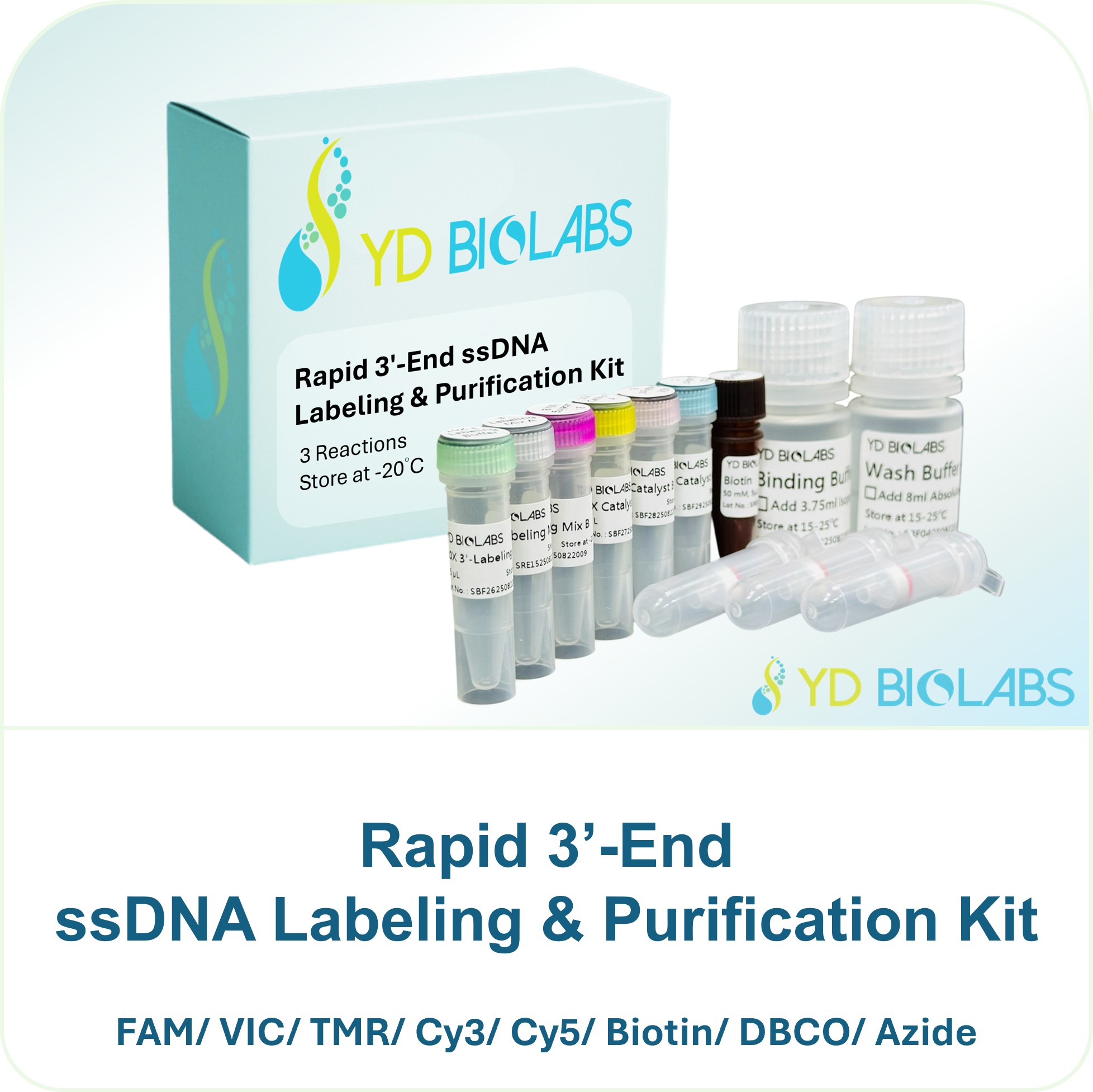
Rapid 3’-End ssDNA Labeling & Purification Kit
| Cat. No. | Product Name | Reaction |
|---|---|---|
| P2010 | P2011 | Rapid 3’-End ssDNA Labeling Kit/with FAM | 3 Rxn | 10 Rxn |
| P2020 | P2021 | Rapid 3’-End ssDNA Labeling Kit/with VIC | 3 Rxn | 10 Rxn |
| P2030 | P2031 | Rapid 3’-End ssDNA Labeling Kit/with TMR | 3 Rxn | 10 Rxn |
| P2040 | P2041 | Rapid 3’-End ssDNA Labeling Kit/with Cy3 | 3 Rxn | 10 Rxn |
| P2050 | P2051 | Rapid 3’-End ssDNA Labeling Kit/with Cy5 | 3 Rxn | 10 Rxn |
| P2060 | P2061 | Rapid 3’-End ssDNA Labeling Kit/with Biotin | 3 Rxn | 10 Rxn |
| P2070 | P2071 | Rapid 3’-End ssDNA Labeling Kit/with DBCO | 3 Rxn | 10 Rxn |
| P2080 | P2081 | Rapid 3’-End ssDNA Labeling Kit/with Azide | 3 Rxn | 10 Rxn |
Description
The Rapid 3′-End ssDNA Labeling Kit is designed to covalently attach a variety of fluorescent dyes, haptens, or clickable tags to the 3’ end of single‑stranded DNA (ssDNA). This kit works directly with ssDNA (20–120 nt) and forms a stable 3’‑terminal conjugate suitable for downstream molecular applications.
A standard reaction can label up to 4 nmol of ssDNA (20–120 nt) with a typical recovery of 80–95% after purification. Labeling efficiency may vary depending on sequence context and secondary structures at the 3’ end. The separation of labeled ssDNA from unreacted components is accomplished with a simple spin-column purification procedure, yielding clean and ready-to-use labeled products.
The resulting 3′-labeled ssDNA can be used in a broad range of applications, including:
Key Features
- Direct 3’-end modification – Works with standard ssDNA (20–120 nt) without requiring special nucleotides.
- High yield and recovery – Typical 80–95% recovery from 4 nmol input.
- Multiplex compatible – Enables simultaneous 3’ labeling of mixed oligo pools in one reaction.
- NGS-ready applications – Optimized for target enrichment, hybrid-capture, and probe-based assays.
- Simple workflow – Efficient labeling and purification with a quick spin-column cleanup.
Applications
This kit enables a broad spectrum of applications in biological research, diagnostics, and analytical workflows. The 3’-end labeled single-stranded DNA (ssDNA) generated can be utilized for:
- NGS target enrichment – 3′ tags enable capture, pull-down, or solid-phase immobilization of probe pools for hybrid-capture enrichment prior to library construction
- Hybridization probes – Use in in situ hybridization, Southern/ Northern blotting, or microarrays where 3′-terminal tags provide detection without interfering with hybridization at the probe core.
- Surface/antibody/drug conjugation – 3′ tags facilitate oriented coupling to functionalized surfaces, antibodies, or small-molecule carriers.
Storage Conditions
| Item | Storage* |
|---|---|
| 10X Labeling Buffer B | -20°C |
| 10X Catalyst A | -20°C |
| 40X Catalyst B | -20°C |
| 50X Catalyst C | -20°C |
| Biotin (50 mM) | -20°C |
| Labeling Enzyme A | -20°C |
| Labeling Enzyme B | -20°C |
| Binding Buffer | 15-25°C |
| Wash Buffer | 15-25°C |
| Oligo-Purification Column | 15-25°C |
*Store all components at their specified temperatures, limit freeze/thaw cycles to no more than 10, protect from light exposure, and handle under aseptic conditions to maintain product quality and integrity.
Datasheet
P2010 | P2011 | P2020 | P2021 | P2030 | P2031 | P2040 | P2041 | P2050 | P2051 | P2060 | P2061 | P2070 | P2071 | P2080 | P2081
MSDS
MSDS-P2000 serial (下載)
Storage and Handling Instructions
To ensure optimal performance and longevity of the kit components, please observe the following guidelines:
- Enzyme, Fluorescent Dye, and Catalyst: Avoid repeated freeze–thaw cycles to maintain activity.
- Light Protection: Keep all fluorescent dyes and dye-labeled products protected from light at all times.
- Storage Conditions:
- Store enzyme components at –20 °C for long-term stability.
- Store Binding Buffer and Wash Buffer at room temperature.
- Reconstitution: Prepare the Binding Buffer, and Wash Buffer strictly according to the kit manual instructions.
- Handling Precautions:
- Always wear gloves when handling materials.
- Use only DNase-free and RNase-free reagents, plastics, and consumables.
- Elution Buffer Use: Use at least 100 μL of elution buffer to ensure optimal recovery of labeled DNA.
Frequently Asked Questions (FAQs)
- Can an oligonucleotide pool (mixture of oligos) be used in this labeling reaction?
Yes. The kit can label oligonucleotide pools. - How can labeling efficiency be confirmed?
Labeling efficiency is typically >90%. Verification can be performed using UREA–PAGE, HPLC, or capillary electrophoresis. - How is the concentration of labeled ssDNA calculated?
Determine OD260 using the formulas provided in the kit datasheet. The molecular weight and extinction coefficient (ε₂₆₀) of your modified oligo are required. Refer to the datasheet section “Concentration Measurement.” - Can the kit be used to modify dsDNA or RNA?
Not recommended. This kit is optimized for efficient 3′-end labeling of single-stranded DNA. If modification of dsDNA or RNA is required, please contact us for alternative solutions.
Troubleshooting Guide
Problem: Low labeling efficiency
- Ensure ssDNA is high-purity (HPLC/desalted); heat-denature to reduce secondary structures at the 3’end..
Problem: Low DNA recovery after purification
- Ensure Binding Buffer and Wash Buffer were properly reconstituted.
- Use at least 100 μL elution buffer and apply directly to the column center.
Problem: Inaccurate absorbance measurements
- Perform a final dry spin (13000 rpm for 3 min) before elution.
- Recalculate concentration using the labeled oligo’s molecular weight and ε₂₆₀ from the datasheet.
- Confirm sample purity using gel or capillary electrophoresis before measurement.
Disclaimer
This product is intended for Research Use or Further Manufacturing Only. Not for use in diagnostic procedures.