
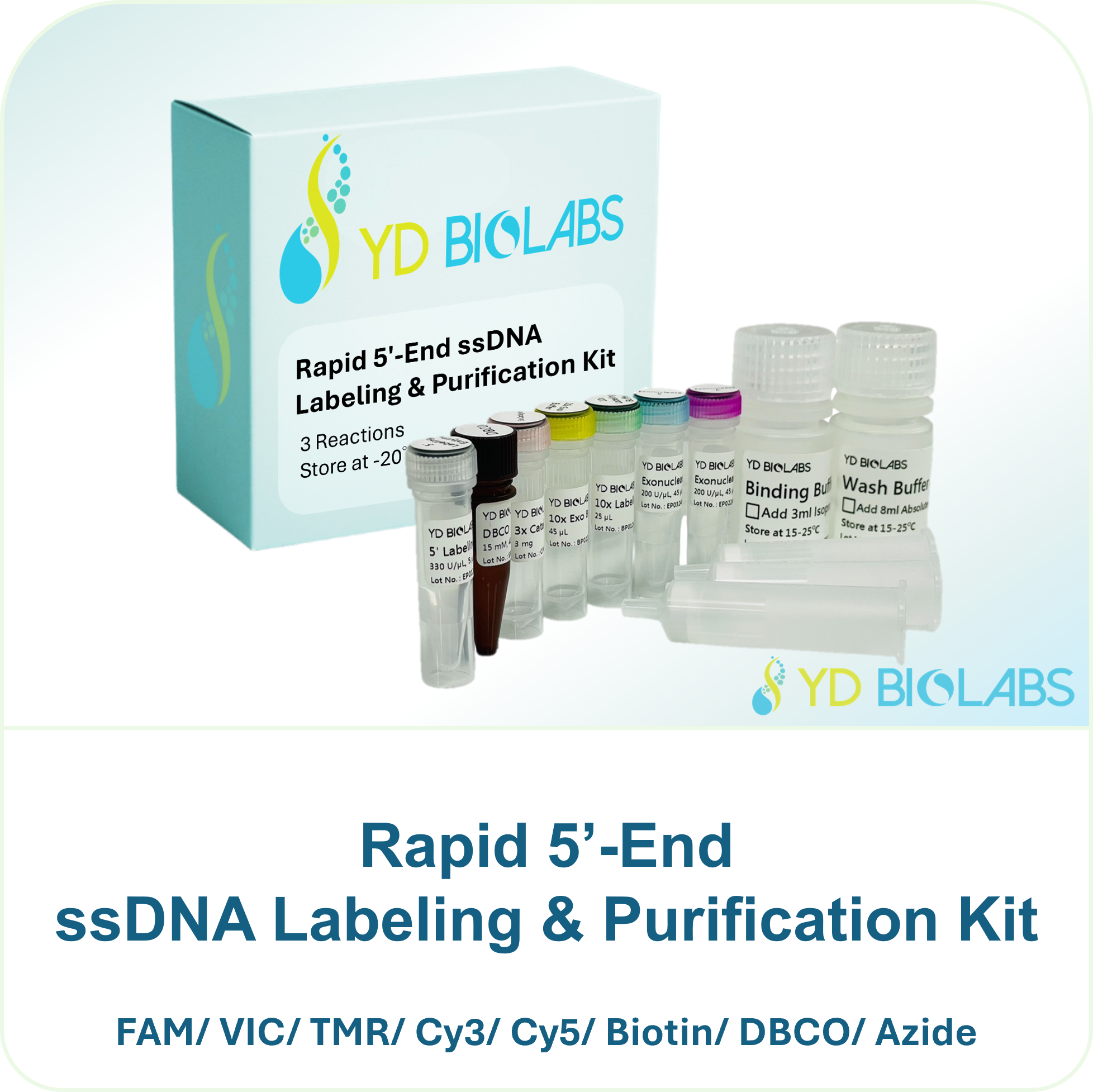
Rapid 5’-End ssDNA Labeling & Purification Kit
| Cat. No. | Product Name | Reaction |
|---|---|---|
| P1010 | P1011 | 5’-End ssDNA Labeling Kit/with FAM | 3 Rxn | 10 Rxn |
| P1020 | P1021 | 5’-End ssDNA Labeling Kit/with VIC | 3 Rxn | 10 Rxn |
| P1030 | P1031 | 5’-End ssDNA Labeling Kit/with TMR | 3 Rxn | 10 Rxn |
| P1040 | P1041 | 5’-End ssDNA Labeling Kit/with Cy3 | 3 Rxn | 10 Rxn |
| P1050 | P1051 | 5’-End ssDNA Labeling Kit/with Cy5 | 3 Rxn | 10 Rxn |
| P1060 | P1061 | 5’-End ssDNA Labeling Kit/with Biotin | 3 Rxn | 10 Rxn |
| P1070 | P1071 | 5’-End ssDNA Labeling Kit/with DBCO | 3 Rxn | 10 Rxn |
| P1080 | P1081 | 5’-End ssDNA Labeling Kit/with Azide | 3 Rxn | 10 Rxn |
Description
The Rapid 5′‑End ssDNA Labeling Kit enables precise, stable modification of single‑stranded DNA at the 5′ end using our patented conjugation technology. This targeted approach preserves probe functionality while allowing efficient attachment of fluorescent dyes, haptens, or click‑chemistry handles.
Ideal for advanced research and diagnostic applications, the kit delivers >90% labeling efficiency with 8–10 nmol yield per reaction and includes all reagents and purification components for a streamlined, high‑purity workflow.
Our kit uses a novel chemistry to form a stable 5′‑conjugate on ssDNA, ensuring long‑term label stability under stringent assay conditions. The integrated spin‑column purification allows rapid processing in just a few hours. It supports applications requiring high‑purity, high‑yield probes.
Key Features
- Patented Chemistry – Stable covalent label
- High Yield – Up to 8–10 nmol per reaction, >90% efficiency
- Complete Kit – Includes all reagents, enzyme, catalysts, buffers, and spin‑columns
- Multiple Label Options – From fluorophores to click‑chemistry handles
- HPLC‑Compatible – For high-purity oligos
- Fast Workflow – Label and purify in a few hours
Applications
This kit enables a broad spectrum of applications in biological research, diagnostics, and analytical workflows. The 5’-end labeled single-stranded DNA (ssDNA) generated can be utilized for:
DNA probes in hybridization techniques such as in situ hybridization, Southern blotting, and Northern blotting
- Probe-based real-time PCR for sensitive and specific nucleic acid detection
- Pyrosequencing and genotyping applications
- Antibody-oligonucleotide or drug-oligonucleotide conjugates
- DNA immobilization on beads, slides, or biosensors
- Electrophoretic mobility shift assay (EMSA)
- Target Gene Catcher or Enrichment for Next-Generation Sequencing (NGS), improving sensitivity while reducing sequencing costs.
Storage Conditions
| Item | Storage* |
|---|---|
| 10X Labeling Buffer A | -20°C |
| Labeling Enzyme A | -20°C |
| 3X Catalyst | -20°C |
| Modifications | -20°C |
| 10X Digestion Buffer | -20°C |
| Digestion Mix A | -20°C |
| Digestion Mix B | -20°C |
| Binding Buffer | 15-25°C |
| Wash Buffer | 15-25°C |
| Oligo-Purification Column | 15-25°C |
*Store all components at their specified temperatures, limit freeze/thaw cycles to no more than 10, protect from light exposure, and handle under aseptic conditions to maintain product quality and integrity.
Kit Content(s)
Item |
Cap color |
Amount
|
Amount
|
Storage1 |
10X Labeling Buffer A |
Green |
15 μL |
50 μL |
-20°C |
Labeling Enzyme A (330 U) |
White |
26 μL |
100 μL |
-20°C |
3X Catalyst |
Pink |
3 mg |
3 mg |
-20°C |
Modifications (50 mM)2 |
Amber Tube |
12 μL |
45 μL |
-20°C |
10X Digestion Buffer |
Yellow |
30 μL |
100 μL |
-20°C |
Digestion Mix A (200 U) |
Blue |
55 μL |
200 μL |
-20°C |
Digestion Mix B (200 U) |
Purple |
55 μL |
200 μL |
-20°C |
Binding Buffer |
15 mL Bottle |
5 mL3 |
12 mL3 |
15-25°C |
Wash Buffer |
15 mL Bottle |
10 mL3 |
25 mL3 |
15-25°C |
Oligo-Purification Column |
|
3 pcs |
10 pcs |
15-25°C |
1 Store each item at the temperature as indicated above. Avoid repeated freeze/thaw cycles.
The kit can go through 10 freeze/thaw cycles with no loss of activity.
2 Modification: FAM, VIC, TMR, Cy3, Cy5, Biotin, DBCO, or Azide. Protect from the light.
3 After Reconstitution.
Storage and Handling Instructions
To ensure optimal performance and longevity of the kit components, please observe the following guidelines:
- Enzyme, Fluorescent Dye, and Catalyst: Avoid repeated freeze–thaw cycles to maintain activity.
- Light Protection: Keep all fluorescent dyes and dye-labeled products protected from light at all times.
- Storage Conditions:
- Store enzyme components at –20 °C for long-term stability.
- Store Binding Buffer and Wash Buffer at room temperature.
- Reconstitution: Prepare the catalyst, Binding Buffer, and Wash Buffer strictly according to the kit manual instructions.
- Handling Precautions:
- Always wear gloves when handling materials.
- Use only DNase-free and RNase-free reagents, plastics, and consumables.
- Equipment Requirements: Ensure access to a centrifuge capable of accommodating 15 mL tubes and operating at 3,000 rpm.
- Elution Buffer Use: Use at least 1.5 mL of elution buffer to ensure optimal recovery of labeled DNA.
Frequently Asked Questions (FAQs)
- Can an oligonucleotide pool (mixture of oligos) be used in this labeling reaction?
Yes. The kit can label oligonucleotide pools, provided each oligo contains a 5′-deoxyU residue. - How can labeling efficiency be confirmed?
Labeling efficiency is typically >90%. Verification can be performed using UREA–PAGE, HPLC, or capillary electrophoresis. - How is the concentration of labeled ssDNA calculated?
Determine OD260 using the formulas provided in the kit datasheet. The molecular weight and extinction coefficient (ε₂₆₀) of your modified oligo are required. Refer to the datasheet section “Concentration Measurement.” - Can the reconstituted catalyst be stored?
For best performance, use immediately after reconstitution. If storage is necessary, aliquot and freeze at –20 °C. Do not refreeze after thawing. - Can the kit be used to modify dsDNA or RNA?
Not recommended. This kit is optimized for efficient 5′-end labeling of single-stranded DNA containing 5′-deoxyuridine (5′-deoxyU).
Troubleshooting Guide
Problem: Low labeling efficiency
- Verify that the oligo contains 5′-deoxyU.
- Confirm that the catalyst was fully dissolved prior to the reaction.
Problem: Low DNA recovery after purification
- Ensure Binding Buffer and Wash Buffer were properly reconstituted.
- Use at least 1.5 mL elution buffer and apply directly to the column center.
Problem: Inaccurate absorbance measurements
- Perform a final dry spin (3,000 rpm, 2 min) before elution.
- Recalculate concentration using the labeled oligo’s molecular weight and ε₂₆₀ from the datasheet.
- Confirm sample purity using gel or capillary electrophoresis before measurement.
Disclaimer
This product is intended for Research Use or Further Manufacturing Only. Not for use in diagnostic procedures.
Datasheet
P1010 | P1011 | P1020 | P1021 | P1030 | P1031 | P1040 | P1041 | P1050 | P1051 | P1060 | P1061 | P1070 | P1071 | P1080 | P1081
MSDS
MSDS-P1000 serial